
Lee Freeston
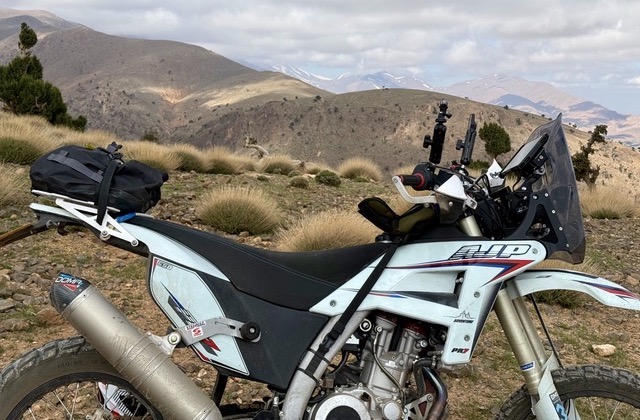
I’d not been to Morocco before but decided the Trans Morocco Trail and High Atlas Traverse would be a great adventure. I bought and prepared a torquey AJP PR7, then fitted a DMD2 navigation tablet. Last week of April I drove up to Wigtown, Scotland to kennel my dog Red with my mate Peter, then once back home I hopped on the Portsmouth to Caen ferry and vanned to the south of Spain.
A new neighbour, Mike, was also into adventure riding and planned to join me on the TMT with his sister on her Yamaha. Better still, he had a place near Almeria to leave my van. I got delayed so we agreed to catch up in Morocco, but two days in, the starter motor on Mike’s Kove 450 disintegrated, so he had to truck back to Nador port and limp home from Almeria.
All this happened just before our planned rendezvous so having got this far I decided to carry on alone. Early summer Spain had been very warm, with clear blue skies and the overnight crossing was calm, but as we drew into Nador, it was lashing down.
Arriving in Nador
The first thing to do was find an ATM and then buy some insurance for the bike. After a couple of hours that was all done so I filled up and booted up the DMD2. I paralleled the first stage of the TMT along the road to get acclimatised to Morocco, then after about 30 miles followed a trail into the mountains.
Two miles on and I could barely see ahead in the pouring rain. This was going to take forever so I backtracked to a small town, got a coffee and booked an Airbnb where I stayed for two nights. By then the weather had cleared and a bright sun lit up the land, so I completed sections A, B and C of the TMT, stopping at the very nice Benyakoub resort in Berrahou on the N15 for another couple of days, taking day rides into the countryside.
Hitting the HAT
I was now ready to head for the High Atlas and Midelt, one end of the High Atlas Traverse, was a hot day’s ride away. Once there I decided to do a test ride on the notorious stage H4 of the High Atlas Traverse. Only a couple of bikes had managed it this year, and it remained impassable to 4x4s.
The first part was easy: flat, hard-packed dirt. I then joined a steady climb for about two hours, but around noon realised I wasn’t going to make it across to Anemzi, far less Imilchil so decided to turn back while I had enough water and fuel. Riding back down I noticed I was getting dehydrated so stopped several times for a drink. (The trail was too rough to use the hydrator’s nozzle on the move.) On the third occasion, I nudged a small rock while pulling away, overbalanced and fell over. As the bike pinned me to the ground, I heard the crack of a bone snapping under the footrest and realised I’d broken my left ankle.

The HAT hits back
Unable to move, I pulled out my mobile only to find there was no signal. I lay there and closed my eyes, and in a moment could see all my family and friends who’d died, my mother, my father, my cousin and my brother who died just last year. I opened my eyes and looked out across the mountains. Although very beautiful, at that moment they were not that appealing to my English heart: scraggy snowcapped summits, stark stony terrain and very little greenery.
All of a sudden I remembered a conversation I’d had many years ago with my cousin Cordell, about his visit to Israel in the early 80s. The gist of it was Israel was a nice place but it definitely wasn’t like England. He recited part of The Soldier, the famous WW1 poem by Rupert Brooke:
If I should die, think only this of me:
That there’s some corner of a foreign field
That is for ever England.
I had a long hard think. I’m the last surviving member of my family. The only thing I had to live for was Red my dog, enjoying himself over 1500 miles away in Wigtown with other dogs and Peter. my mate. At this point I spoke the words ‘not today’ to no one in particular. After some shoving and sliding, I managed to extract my left leg from underneath the bike. When I stood up the pain was excruciating, but if I was to get off the mountain I had to ignore it. I’ve decades of MX and supermoto racing behind me so am no stranger to fractures.
The next task was lifting 165 kilos of PR7 with one leg, getting back on and riding down to Midelt and hopefully a hospital. Luckily, before I left for Morocco I’d made the fortuitous purchase of an Eastbound MotoWinch. I assembled the jack, attached the strap to the handlebar and on the second attempt, got the bike leaning on its stand.
Suddenly I thought I was bleeding, but it was a false alarm; the burst water bladder was running down my leg. That was going to be a problem later on. Once back on the bike, it started on the button, and I set off, changing gear with my heel.
Self extraction from Jebel Ayachi
A few days earlier I’d bent the rear brake lever and in my current condition it was impossible to operate. Relying on only the front brake was sketchy if I wasn’t to low-side down some loose hairpin. Instead I used the kill switch and clutch on the steeper descents which worked very well until the PR7 small battery started complaining from the frequent restarting. S at times I sat there letting the battery charge up for the next descent.
Using this technique for almost two hours and 30 miles, I managed to extract myself from the mountains back to Midelt by which time I was totally exhausted and very dehydrated. Barely able to think straight, if I even stopped to get some water I’d be unable to carry on so semi-coherent, I blundered back to the guesthouse.
Once there I tried to speak with the cleaner, but she didn’t understand English so I sat down in the dining room and waited. Half an hour later, Simo the owner arrived and I explained my plight. He gave me a bottle of water then returned in an ancient, matt black Renault 4 with touch-wire starting. I hobbled in and Simo took me to the hospital. Security guards were at the gate with lots of people trying to get in. Simo had a chat and I was allowed in and got wheeled to a triage room with a doctor, a nurse and many other people with injuries and ailments.
A&E
To my surprise, I was seen straight away. The first thing they wanted was my passport and where I was staying. After some form filling I was taken for an X-ray. Two nurses explained the left boot was going to have to come off. Better than the foot, I suppose. I expected some large cropping shears but no, this is Morocco. They don’t waste money on things like that. I was taken to a ward, a screen was put around me and a nurse jabbed me in the buttock with some painkillers. Oddly, from my return from the mountain I’d not felt any pain. Adrenaline, or some other ‘fight-or-flight’ hormone had conveniently seen to that.
The boot was removed, X-rays were taken and I was back in triage in the wheelchair. The X-rays showed a simple fracture. I can live with that, I thought. Simo went to a pharmacy to buy materials to make my cast and once he returned, nurses encased my ankle in plaster. As they tried to set my leg I started getting bad dehydration cramps which the nurses found extremely funny. They got some bottled water and told to drink up so they could finish the job.
A doctor came back into the room to outline some dos and don’ts, explaining it was a clean break which would heal in a month and said I was good to fly in a few days but should then see an orthopaedic specialist once back home. He said with a wry smile I should expect a long wait at my local hospital; his father was a consultant cardiologist in London and knew what the UK’s NHS was like!
Simo kindly drove me back, explaining he’d pop out and get the crutches once he’d dealt with some new guests. Outside the guest house I struggled out of the car. A waiting backpacker saw me and walked over, one prosthetic leg flashing with LEDs.
‘What you done, pal?’
‘Snapped my ankle up on the mountain. It’s not too bad’ I explained.
‘Don’t worry, I lost this in Iraq and here I am’ he said encouragingly, pointing to his false leg.
‘Use these’ he said, pulling out a pair of collapsible, carbon fibre crutches from his rucksack.
‘Keep ‘em till the morning. I can manage without them’.
What an absolute star. True to his word, Simo turned up later that evening with a set of regular crutches from the pharmacy, and I returned the high tech sticks to my army friend.
Flying Home
After five days lying in a darkened room in a foreign country that was forever Morocco, I decided it was time to go home. I organised an easyJet from Marrakesh to Gatwick and left the bike at Simo’s mother’s place in Midelt. We drove to Marrakesh and Simo dropped me off at the airport next day. The disabled assistance I’d requested never appeared, so I hobbled round the concourse. I had to register my bike with the Customs in the departure area and was absolutely astounded by the service. An officer showed me to the office, filled out the forms for me then in broken English explained he’d take me to my plane. I was escorted straight through passport control to my departure gate.
Landing at Gatwick, disabled assistance was waiting and a friend, Lucy, organised a taxi. But back home I had realised my keys were in the van in Spain, so I had to break into my own house by climbing through a window with a leg in plaster. Nothing’s ever easy!
The doctor in Midelt had guessed right. I tried phoning the local hospital’s orthopaedic department. but nobody answered or replied to online queries. I decided I’d go to Chichester hospital and many hours later they removed the plaster and sent me for for X-rays.
‘Looks like a clean break, chum. We’ll give you a plastic boot. Wear this by day; take it off at night. You can start weight-bearing within seven days, but be careful.’
The only worrying thing was I still had no pain, so I took it easy. I never did see a specialist but got a call ten days later to verify I was still breathing. Make up your mind what sort of service I got: was it better in Morocco or in England?
Retrieving the AJP
Nine weeks after breaking my ankle Lucy and I flew to Fez – the middle of the brutal Moroccan summer. She’d booked a riad in the heart of the souk which turned out to be a great choice with a teeny pool, air-con and a roof garden looking out over the ancient city. We took a guided tour through the souk which was very interesting, passing many exotic mosques and the world’s oldest university, founded in 859AD.
We met Simo next morning and drove to Midelt via Ifrane ski resort in the Middle Atlas, with incongruous, alpine-style chalets and where the king had one of his palaces. Around here Simo failed to spot a speed trap and copped a 300 dirham fine, about £25.
Back to Nador
At Simo‘s mum‘s in Midelt the PR7 fired up first time, but we’d failed to factor in a roadside kebab we’d eaten on the way and all spent the next three days doubled up with stomach cramps while clutching a toilet roll. Once we got over that, Simo agreed to drive Lucy to 400km Nador while I rode the AJP. For me this was going to be a big ask just ten weeks after a broken ankle and what was now 40°C mid-summer heat, so I decided to break it into two days. Two miles down the road the satnav lost the route and gpx after I switched off to fill up. I thought oh well I’ll just use the iPhone. That didn’t work either as the screen packed up in the heat. I thought well Red always finds his way home so I went old-school and jotted down directions on a bit of paper taped to the tablet.
By now I’d learned it was important to drink on the move and was sucking regularly from the bladder, but even then my mouth was parched ten minutes later, so stopped twice to buy more water. I was chuffed I could still navigate with just a piece of paper stuck on the satnav, just like we did before all these gadgets appeared.
We overnighted at the Benyakoub resort in Berrahou on the N15. They remembered me from May and I had a long chat with the owner who was interested in getting into adventure riding himself. He said a lot of bikers pass through, but in the summer only had locals, mad dogs and an Englishman!
The resort was full of holidaying Moroccans, laughing and dancing till 2am. With no air-con the July heat was unbearable, so I opened the door and set the fans up, but about 4am woke up with four frogs jumping about and an infestation of scurrying cockroaches. I took a swim to cool off and returned to find ants attacking the cockroaches. So I flushed the cockroaches down the toilet and sprayed repellent on the ants.

It was another excruciatingly hot ride 200km to Nador, with several stops under railway bridges to cool off. By Nador I was exhausted from chasing Simo through the traffic and felt like I was coming down with heat stroke, so drank a litre of full-sugar Coke and another of water which kept me going until we reached the Airbnb.
Queueing with the cars and motorhomes at Nador port next morning, a massive 4×4 truck was being searched by the border force who dragged out some stowaways and led them away in handcuffs. Meanwhile, I chatted with a Dutch guy on a Harley who noticed I wasn’t walking so well. I explained my situation so he pulled out a collapsible camp chair and said sit on that, we’re going to be stuck here a while. As I was learning, people have the habit of coming to your aid when least expected.
Back in Spain with the bike in the van, over the next few weeks Lucy and I stayed in some very nice places until she had to fly back. I drove on to the Algarve, then up through Portugal which was a lot cooler than Spain. After some gentle off-roading in the Picos, I carried on up through France and back to Caen and as you read this, I’m travelling up the motorway to collect Red from Scotland.
Lessons Learned
Many solo bikers rightly worry about getting into trouble in foreign lands and how they’d cope far from their support network. The biggest takeaway from the whole experience was that, after a brief existential wobble, I was able to think logically to extricate myself from the mountain. The bigger lesson was the unconditional kindness and hospitality of people like Simo, the one-legged squaddie, the cop at Marrakech airport and the Dutch chair guy. It was worth the pain to learn these important lessons.


Leave a Reply