
Note: This article is an updated version of the Melilla-specific post shared in November 2024.
A bit of context
When crossing the Mediterranean from southern Spain to begin the TMT you have a choice, depending on your timings and how you want to handle the border and customs control – you can either can a get a boat to Melilla, which is Spanish territory, or you can get a boat to Nador, which is Moroccan territory.
Melilla is, along with Cueta to the west, one of two small Spanish enclaves on the Moroccan Mediterranean coast, a legacy from colonial times. It is about 16km (10miles) to the north of the port of Nador, where the Trans Morocco Trail begins at the seafront Cherry & Berry cafe.
Nador-proper is about 15 mins to the south of the Spanish enclave, but the city’s port is actually to the north at Beni Ansar, directly next door to its Spanish cousin and just over the frontier in Morocco.
In practice this means…
Melilla
If you’re crossing by boat to Melilla, you’re not leaving Spain until you cross the land border from Melilla into Morocco, a few kilometres from the port. That means you won’t have to undertake customs and passport control checks before you get on the boat from one of Spain’s southern ports nor when you (initially at least) get off the boat on the other side.
Being part of Spain means that the enclave is also part of the EU:
- Vehicle insurance, health insurance etc that you have which is valid in the EU is valid here too.
- If (for example as a Brit) you’ve only got a certain number of days a year that you’re allowed to have your vehicle in the EU from a customs and insurance perspective, then being in Melilla counts.
- Your mobile phone should have reception via a Spanish network (rather than a Moroccan one).
- If you need to change your ferry booking, you will not be able to change it to Nador or any other Moroccan destination. However if you have booked a ticket to Nador, you can change it to other Moroccoan destinations.
There’s also a smattering of mechanics within the enclave (a simple search of Google Maps shows this). Practically speaking, this is potentially useful if you need parts quickly, as you’ll benefit from being inside the EU and the range of options that gives you for speedy delivery compared to Morocco.
The one difference with mainland Spain is that petrol prices are (as of late 2024) more aligned with the cheaper prices you get in Morocco.
Nador
Nador is a different proposition, because when you’re leaving continental Spain, you’re actually leaving Spain, so you’ll need to get everything you need that you might struggle to get in Morocco before you get on the boat.
Practically speaking, that means you’ll be stamped out by Spanish passport control as normal before you board the boat.
There is, at the time of writing (April/May 2025), a downside to this crossing; if you are crossing to/from Almeria with Trasmediterranea overnight and plan to sleep on the seats rather than fork out for a bed/cabin as many TMTs will do, you should note that seating is limited and the allocation of one seat per person not enforced for sleeping purposes. As a result, you may find it difficult to find a decent spot to sleep.
Getting off the boat and through the border
Melilla
As you come off the boat, you’ll be waved through by the port/police officers, possibly with a few questions along the way. If you (like me) don’t believe in doing border crossings on an empty stomach, there’s a McDonald’s and some cafes and restaurants nearby, where you can fuel yourself for the crossing ahead.
The border crossing is about 5 to 10 minute drive/ride from the port and is between Meillia and Beni Ansar, on the Moroccan side, which you can find here (GPS: 35.269854, -2.934917):
- The Spanish side is usually pretty efficient. Typically they’ll just want to look at your passport and stamp you out.
- Once through the Spanish side, you then have to wait in a queue in a narrow strip of no man’s land before reaching the Moroccan border kiosks. Note: This can take time, dependent on circumstances: TMT-ers have reported wait times from 20 minutes to a few hours.
- The Moroccan side is less speedy and requires some patience. At the kiosks, you will be told where to go, but normally you will be directed to a small Portacabin on your right hand side, past the control, to complete the necessary customs procedures.
- You’ll need your vehicle registration papers. If these are not in your name, then you’ll need a printed (i.e. not just on your phone) letter authority from the person named on the papers as the vehicle owner, which is dated and signed, providing you with authorisation to take the bike into Morocco.
- You can not buy vehicle insurance here, but you will not be asked for that either. You need to head to Nador to do this. Whilst it’s tempting to skip doing this, we strongly recommend that you do not do so.
Nador
The good news is that for crossings to Nador, Moroccan passport control (but not customs) is done on the boat on the way over.
Chris has an excellent and detailed write up of the procedures on his website here, which is worth reading and familiarising yourself with before you get on the boat (which may/may not have internet coverage!).
Sorting cash and SIM cards en route
Once through border and customs control and into Morocco-proper at Beni Ansar via either crossing, you will soon find your Spanish mobile phone reception will drop off and you will need cash to pay for your insurance at the office in Nador:
- We recommend avoiding the usual hustlers immediately after the border crossing, offering SIM cards and money exchange.
- Instead head five minutes down the road into Beni Ansar.
- At a small shop selling the usual confectionery and food here (GPS: 35.260723, -2.939026), you can also exchange Euros for Moroccan dirhams at a reasonable rate and buy and top-up a Maroc Telecom SIM card.
- The owner of this shop proved himself to be particularly helpful (in November 2024) in setting up SIM cards, hence the recommendation in this post.
- In addition, there’s an excellent breakfast on offer at Cafe Al Aakaba, opposite.
Insuring your vehicle
With some cash and mobile phone reception sorted, it is a 15 minute ride to the insurance office, in Nador:
- You’ll see other insurance offices en route, but they will likely redirect you towards this one, as not all insurance bureaus sell motor insurance for foreigners.
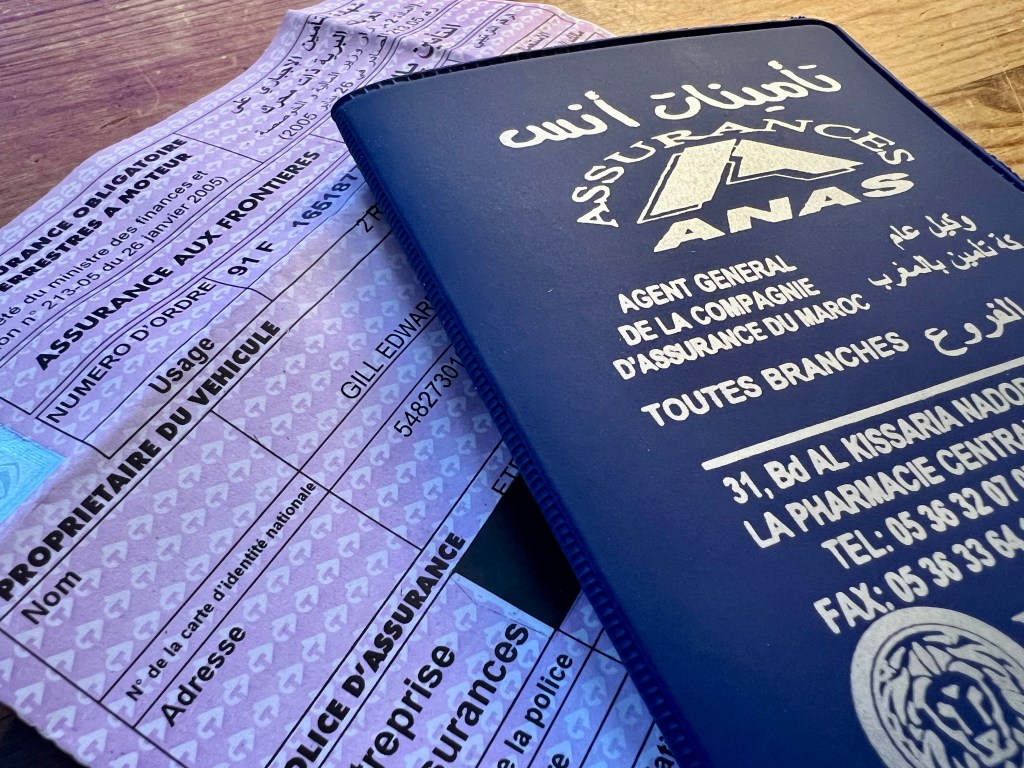
- The insurance office is called RMA Assurance Anas and is here (GPS: 35.179647, -2.926934), behind the Hotel Ryad.
- Note: If you search Google Maps for Assurance Anas, it will take you to an incorrect location.
- Once inside, you’ll need to decide whether to buy third party insurance for 10 days (c. 60 euros) or 30 days (c. 90 euros), providing your passport and vehicle registration papers to the helpful team behind the desks.
And that’s it! From there, it’s a ten minute ride or drive to Cherry & Berry cafe and the start of the Trans Morocco Trail.

 Trans Morocco Trail
Leave a comment